Creative velocity for UA teams
- New concept to live adTraditional pipeline 1–3 weeksSmartUGC pipeline Same day
- Cost per videoTraditional pipeline $100–$500 (agency/creator)SmartUGC pipeline $5–$10
- Hook variations per conceptTraditional pipeline 2–3 (budget-limited)SmartUGC pipeline 6–10 (video-limited)
- Refresh cadence sustainableTraditional pipeline MonthlySmartUGC pipeline Weekly
- Localised variantsTraditional pipeline Per-market creator sourcingSmartUGC pipeline 25+ languages, same actor
- Gameplay integrationTraditional pipeline Editor stitches captureSmartUGC pipeline B-roll + your capture, same flow
The creative fatigue treadmill
App UA has a property ecommerce mostly escapes: the audiences are huge, the frequency is brutal, and a winning creative dies publicly, in your dashboards, within weeks. Meta and TikTok reward fresh creative with cheaper installs, then punish stale creative with rising CPIs, forever. The teams that win are not the ones with the single best ad; they are the ones whose pipeline reliably produces the next ad before the current one fades.
That pipeline has historically been expensive in exactly the wrong way. Agency-produced UA video runs $100 to $500 per finished concept, creator-sourced "real player" testimonials take weeks to brief and deliver, and both price points force rationing: two or three hook variations per concept, monthly refreshes, and painful bets on which concept deserves the budget.
At $5 to $10 per video, rationing stops being the constraint. A UA manager can put six hooks on a concept, refresh weekly, and localise the winner, for less than one agency video used to cost. The scarce resource becomes what it should have been all along: ideas worth testing, and the discipline to read the results.
What AI UGC actually covers in an app funnel

The formats map cleanly onto what UA teams already run.
The talking-head hook is the workhorse: an actor delivering "I was today years old when I found this app" straight to camera, cut against your screen recording. Generate the talking-actor segment, stitch your captured gameplay or app footage in your editor, ship. The actor segment was always the expensive, slow half; now it is the cheap, fast half.
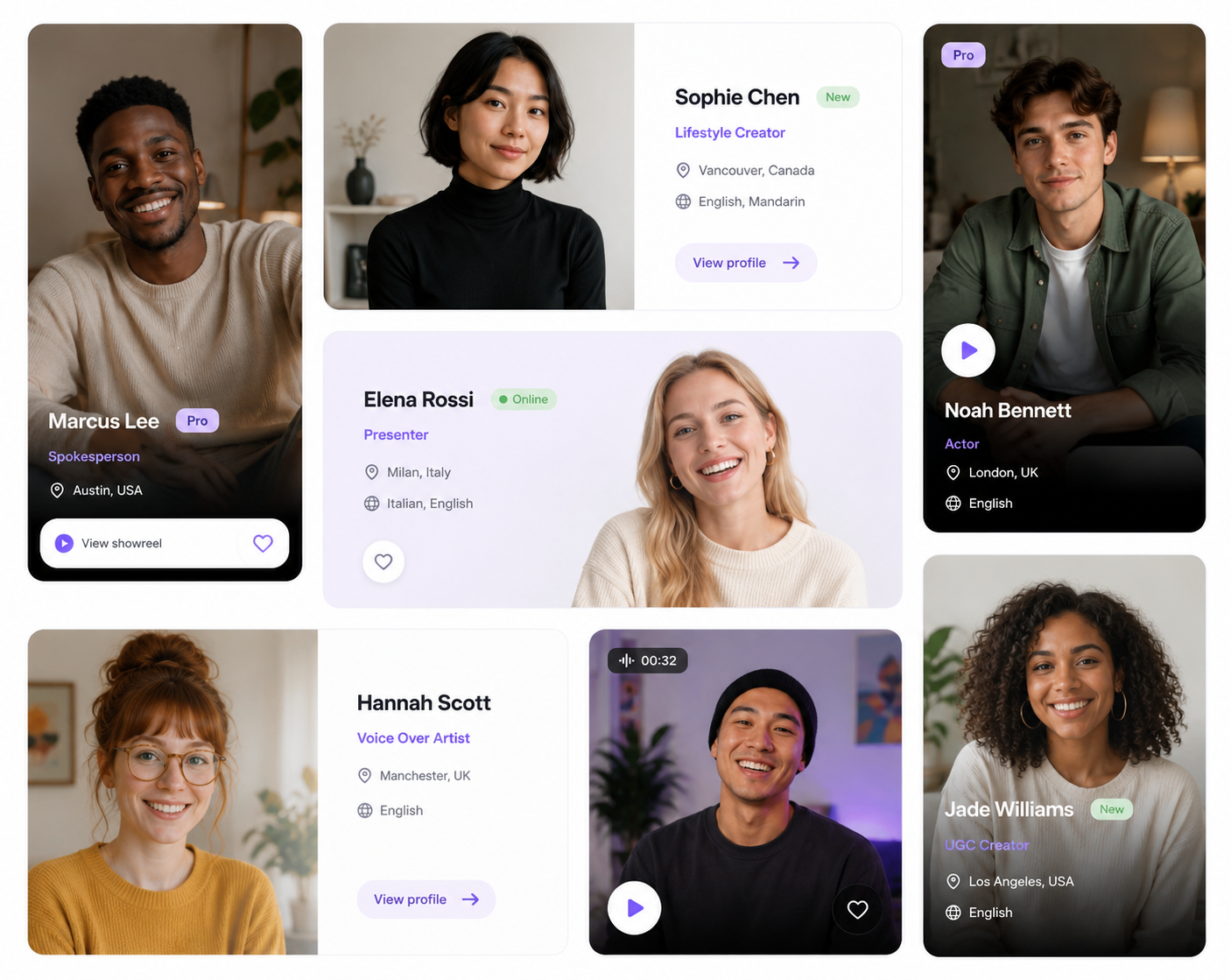
Phone-in-hand works as the app world's product-in-hand: the actor holding a phone, reacting to what is on screen, is the classic UGC frame for both games ("this hospital game has me in a chokehold") and utility apps ("my boiler broke down and every plumber quoted me differently", which is exactly the style of ad running in our own showcase rail above). It is included from the $69 Creator plan, not gated behind a top tier.
B-roll generation fills the lifestyle cutaways: the morning-routine shot for a habit app, the commute shot for a podcast app, the desk shot for a productivity tool, without stock-footage licensing or the stock-footage look.
And AI image ads, included on every plan, cover the static and playable-adjacent slots in your channel mix that video-first tools ignore.
What it does not do: capture your gameplay, edit your final cut, or design your store page. It manufactures the human-shaped half of UA creative; your editor still owns the assembly.
The math per install, not per video
UA teams should price creative in CPI impact, not production cost, so run that lens honestly.
Creative testing exists because hook quality moves CPI by multiples, not percents. A mediocre hook at a $4 CPI and a strong one at $1.80 is the difference between a dead channel and a scaling one, and nobody can predict which hook is which; the whole discipline is testing enough of them. When each variation costs $300 and two weeks, teams test three and pray. When each costs under $10 and an afternoon, testing ten is a Tuesday, and the odds of finding the $1.80 hook scale with the attempts.
Concretely: a studio on the Studio plan ($119, 20 videos) runs four concepts a month at five hooks each. If one hook in twenty cuts CPI even 20% on a $30K monthly spend, that is $6K of monthly efficiency against $119 of tooling. The asymmetry is silly, which is why funded studios adopted this category first, and why paying premium in-app rates for it is no longer necessary: SmartUGC delivers the same testing loop at the lowest per-video cost in the field.
Localisation compounds it. A winning hook re-rendered into 25+ languages with the same actor costs one video per market, versus re-sourcing creators per geography. For hyper-casual and utility apps where tier-2 and tier-3 geos carry the volume, that alone can justify the subscription.
Store policies, ad networks, and the honesty constraint
App advertising has a compliance layer ecommerce lacks, so address it squarely.
Misleading-gameplay rules bite harder than AI rules. Apple, Google, and the major ad networks have spent years tightening policies against ads that misrepresent what an app does (the "fake gameplay" wars). An AI actor enthusing about features your app lacks is a policy strike and a wasted install budget regardless of how the video was produced. The actor reads your script with conviction; write scripts your app can cash.
Synthetic-content disclosure is arriving unevenly: platform rules on flagging AI-generated ad creative are evolving quarter by quarter, and UA teams should assign an owner to track them per network. The assets themselves are royalty-free with no usage limits, so rights management, at least, is simpler than creator whitelisting ever was.
The soft constraint is taste. App audiences, especially gamers, have sharp radar for inauthentic enthusiasm, and the uncanny floor of lazy AI UGC ("this app changed my life", generic actor, no specifics) burns audiences fast. The ceiling (a specific claim, a real screen recording, an actor cast to match the player base) performs because it respects the viewer. The tool prices both the floor and the ceiling under $10; which one you ship is editorial.
Fitting the tool stack, and where SmartUGC sits
Most UA teams shopping this category compare SmartUGC against MakeUGC and Arcads, so here is the honest read from an apps seat.
SmartUGC's pitch for UA is direct: the lowest per-video cost in the field, from $5, every relevant format from the $69 Creator plan, bulk creation for hook matrices on all plans, both Seedance 2.0 and Veo 3 rendering named on every tier, and videos that roll over when you upgrade. Every plan renders publishable, watermark-free ads, so the evaluation is one afternoon against your current control creative, and you can get started today. Refresh cadence is the whole game here, and nothing gets rationed by plan.
Arcads shows its pricing in-app after sign-up (figures as displayed in-app, July 2026, with no trial listed at the time of writing) and works out to about $11 per video, where SmartUGC videos start from $5 with the full catalogue on every plan; the head-to-head is here. MakeUGC ships an API ($99 to $299) if you want generation wired into an internal pipeline, though its product-in-hand format sits on the $149 Pro plan and its credits meter model usage with no published per-video rate; pricing decode here.
Whichever you pick, the roundup places all four majors side by side, and the stack conclusion is usually the same: AI for the human-shaped segments, your capture pipeline for truth-in-gameplay, your editor for the cut. On cost per test, formats-per-plan, and time-to-first-ad, SmartUGC is the one that lets you run the most experiments per dollar.
- Lowest cost per hook test
- A fixed price per finished video
- Real, watermark-free ads you can publish
- Product-in-hand on a lower plan
- Every ad format without an upsell
- Know exactly what renders your ad
- Scale up without losing what you paid
- Keep running ads after you cancel
Outrun the fatigue curve
UA creative is a treadmill, and the teams that win set the treadmill's speed for everyone else. AI UGC at $5 to $10 a video means hook matrices instead of hook bets, weekly refreshes instead of monthly rationing, and localisation as a render setting instead of a sourcing project. Your gameplay capture stays real, your claims stay honest, and your pipeline stays ahead of the burn. Get started and put six hooks on your current control by Friday.
Questions, answered.
Can the AI actor hold a phone showing my actual app?
The actor can hold and react to a phone naturally; your actual screen content is best added as an overlay or cut-in with your editor, using your real captures. Most UA teams generate the actor segments in SmartUGC and stitch gameplay in their existing editing workflow, which also keeps you safe on truthful-gameplay policies.
Is AI-generated ad creative allowed on Meta, TikTok, and AppLovin?
Yes, subject to each network’s evolving synthetic-content disclosure rules and, more importantly for apps, the long-standing rules against misrepresenting app functionality. An AI actor making claims your app cannot cash is a policy problem regardless of how the video was made. SmartUGC output is royalty-free with no usage limits, so the rights side stays simple.
How fast can we localise a winning creative?
A winning script re-renders in any of 25+ languages with the same actor at one video per version, so a ten-market rollout is ten videos and an afternoon. The actor stays consistent across every market, which keeps a recognisable creative identity as you scale into tier-2 and tier-3 geos.
What does each finished video actually cost?
Each plan is a fixed number of finished videos, and across the plans that works out to $5 to $10 per video: $49 for 5 (Spark), $69 for 10 (Creator), $119 for 20 (Studio), $249 for 50 (Agency). There are no per-second or per-video caps layered on top, so your cost per hook test is fixed and easy to model against CPI impact.
What plan fits a small studio testing one title?
Studio at $119/month (20 videos) fits most single-title testing cadences: four concepts at five hooks monthly. A soft-launch title can start on Creator at $69 and upgrade mid-cycle without losing videos, since they roll over on upgrade. Product-in-hand and custom avatars are both included from that $69 Creator plan.
Can I test it against my control before scaling spend?
Yes. Every plan renders watermark-free, publishable ads, so you can test a real hook against your current control creative on a small media budget before you scale. Plans start at $49, and you can cancel anytime.
Which render models does SmartUGC use?
Both Seedance 2.0 and Veo 3 are named and available on every plan, not reserved for a top tier. Failed generations are refunded automatically, so a bad render never costs you a video.
Does this replace our UA agency or editor?
No. It replaces the expensive, slow half of creative production: the on-camera human segments. Strategy, gameplay capture, final edit, and channel management stay wherever they live today. Several UA agencies use SmartUGC themselves; the margin math is on our agencies page.
Can we bulk-produce a whole hook matrix at once?
Yes. Bulk creation is on every plan, so you can queue a full matrix of hook variations against one concept in a single pass rather than generating them one at a time. That is the workflow that turns testing ten hooks into a Tuesday instead of a project.
How does SmartUGC compare on price to Arcads and MakeUGC?
SmartUGC starts at $49 for a full plan, and its per-video cost of $5 to $10 is the lowest in the field. MakeUGC publishes plans from $59, and Arcads shows its pricing in-app after sign-up (figures as displayed in-app, July 2026, with no trial listed at the time of writing). The side-by-side comparisons are linked throughout this page.
Related guides
The complete toolkit for
modern advertisers.

One subscription. Unlimited creative.
Create scroll-stopping videos
in seconds.
Start now and cancel anytime.